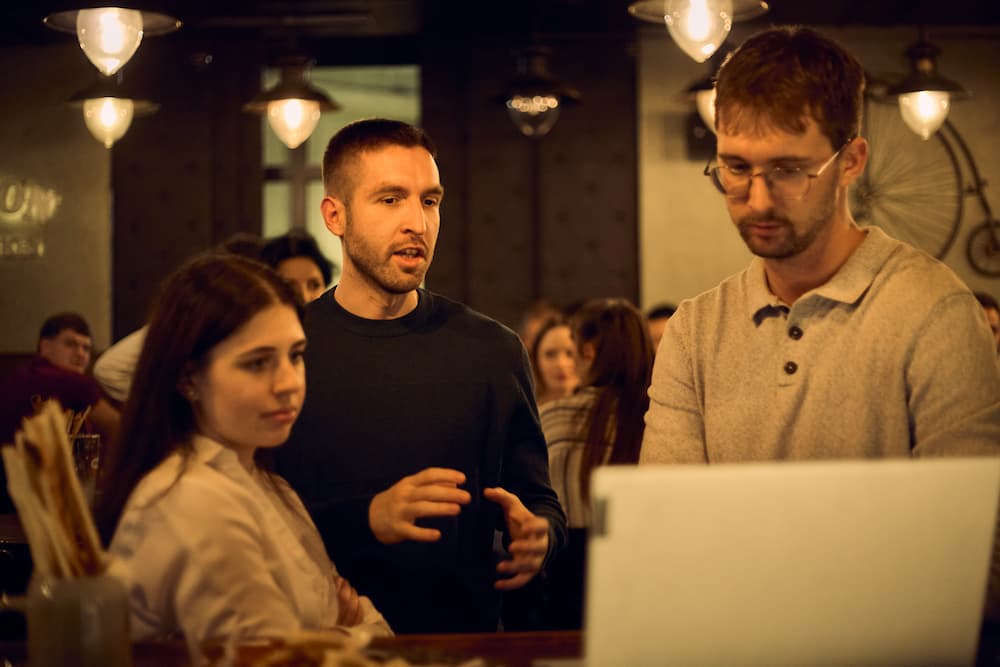
As software systems grow, architecture often struggles to keep up. This article reflects on our first architecture session with IcePanel, exploring why teams lose clarity over time and how shared models, practical tooling, and real project experience can help keep systems understandable as they evolve.

Software systems rarely start complex. They grow over time, new services are added, teams change, and decisions made early on are not always documented clearly. At some point, architecture stops being something everyone understands intuitively and starts becoming harder to explain, maintain, and evolve.
This is a challenge we see often in our work at Sotex. It is also the reason we decided to organize our first architecture-focused event, together with IcePanel.
The idea was not to host a polished conference or promote tools for their own sake. We wanted to create a practical setting to discuss how teams actually work with architecture day to day and how they can make that work easier.
Where teams usually lose clarity
In many teams, architecture knowledge lives in people’s heads, scattered documents, or outdated diagrams. As systems grow, this leads to confusion rather than clarity.
Documentation often ends up spread across multiple tools. Diagrams are created once and rarely updated. Architecture discussions happen, but the outcomes are hard to revisit or share across teams. This rarely comes from a lack of skill. More often, it comes from a lack of structure that fits naturally into everyday development work.
These were the kinds of realities we wanted to focus on during the session.
Introducing a shared way to describe systems
The session opened with Tim Gaweco and Jacob Shadbolt from IcePanel, who introduced the C4 model and explained how it helps teams describe software systems at different levels while keeping a shared language.
Rather than treating architecture diagrams as static artifacts, they showed how modeling can stay connected to how systems actually evolve. A short demo of the IcePanel software illustrated how diagrams can remain useful, editable, and relevant over time.
Alongside the presentations, we set up several stations where participants could try the IcePanel tool themselves. This hands-on part helped ground the concepts in real usage and gave people space to explore how visual modeling supports everyday architecture work.
What this looks like in real projects
In the second part of the session, Mladen Stanojević (CEO & Founder) and Mladen Stanojević (Solution Architect) shared examples from projects delivered at Sotex.
They spoke about architecture tooling, microservices, and how modeling fits into agile methodology when systems are already live and changing. The focus stayed on practical trade-offs, long-lived systems, and the need for models that help teams communicate rather than slow them down.
The discussion stayed close to real constraints. Changing requirements, distributed teams, and evolving architectures are a given in most modern software projects, and any approach to architecture has to work within that reality.

Why this matters to us
Clear architecture is not about perfect diagrams. It is about shared understanding.
When teams understand how systems fit together, they make better decisions, onboard faster, and avoid unnecessary complexity. Tools and models only matter if they support that shared understanding and fit naturally into how teams already work.
This event was our first time organizing a session like this, but it reflects how we approach engineering at Sotex. We see architecture as something that lives alongside development, not above it, and we value partnerships like the one with IcePanel because they align with that mindset.
Looking ahead
We plan to continue creating spaces where engineers can explore practical topics, share experiences, and learn from each other. This session was a starting point, not a one-time effort.
If you are interested in future events or want to learn more about how we approach software architecture and system design in real projects, we are always open to continuing the conversation. Whether as collaborators, partners, or peers, we believe strong systems are built through shared understanding and long-term thinking.
