How Apache Spark, Scala, and Entity Resolution help banks turn billions of disconnected records into meaningful intelligence.
A Bank Has Millions of Customers. But Does It Really Know Who They Are?
Imagine a bank with 10 million customers, hundreds of millions of transactions, and data distributed across dozens of systems.
A customer appears in the core banking system under one name, in a payments platform under another, and in a business registry as the director of several companies. Different addresses, slightly different names, and incomplete identifiers make it difficult to recognize that these records are connected.
Now imagine trying to identify those relationships across billions of records.
Traditional databases and simple matching rules aren’t always enough.
This is where Quantexa Decision Intelligence, Apache Spark, and Big Data engineering come together.
Quantexa helps financial institutions connect fragmented information using Entity Resolution, Graph Analytics, and Network Generation, revealing relationships that would otherwise remain hidden.
But behind these capabilities lies a substantial engineering challenge: integrating, processing, and analyzing enormous volumes of complex data, reliably and at scale.
The Big Data Problem Behind Financial Crime Detection
Banks generate enormous quantities of data every day.
Customer records, payment transactions, account activities, company registrations, addresses, beneficial ownership information, and external data sources all contain pieces of a much larger picture.
The challenge is not simply storing this information.
It’s making sense of it.
Consider a hypothetical Anti-Money Laundering (AML) investigation involving five companies.
Each company has a different name and registration number. Their transactions appear legitimate when analyzed individually.
But after connecting information from different sources, an investigator discovers:
· Three companies share directors or beneficial ownership relationships.
· Two use addresses linked to the same business network.
· Several accounts transfer funds through common intermediaries.
· A previously unidentified customer connects multiple parts of the network.
What initially looked like unrelated transactions becomes a potentially relevant network of financial activity.
This is the value of Quantexa Entity Resolution and Network Analytics: moving beyond isolated records to understand the relationships between people, organizations, accounts, and transactions.
However, discovering those connections across massive datasets requires serious data processing capabilities.
Apache Spark and Scala: The Engineering Foundation of Quantexa
Quantexa’s architecture uses Apache Spark and Scala for distributed batch data processing, enabling large-scale entity resolution, graph generation, and analytics.
This makes Big Data engineering an important part of Quantexa development.
Processing Billions of Records with Apache Spark
Apache Spark is a distributed data processing engine designed to work with datasets too large or computationally intensive for conventional single-server processing.
Instead of processing all information on one machine, Spark distributes workloads across multiple computing resources.
In Quantexa environments, Spark-based processing supports activities such as:
· Ingesting and transforming large banking datasets
· Preparing customer, organization, account, and transaction data
· Executing batch Entity Resolution workloads
· Building connected data structures and networks
· Running analytical calculations and scoring workloads
· Processing large volumes of data efficiently and consistently
For financial institutions handling millions of customers and billions of transactions, distributed processing is an essential architectural capability.
But using Spark doesn’t automatically guarantee good performance.
Data partitioning, memory management, inefficient joins, data skew, and poorly designed transformations can significantly affect processing times and infrastructure costs.
This is where experienced Apache Spark and Scala developers become particularly valuable.
Entity Resolution: Finding the Real Customer Behind the Records
One of the most important capabilities of Quantexa is Entity Resolution.
In simple terms, Entity Resolution identifies records that refer to the same real-world person, company, or other entity, even when the available information is incomplete or inconsistent.
Consider these customer records: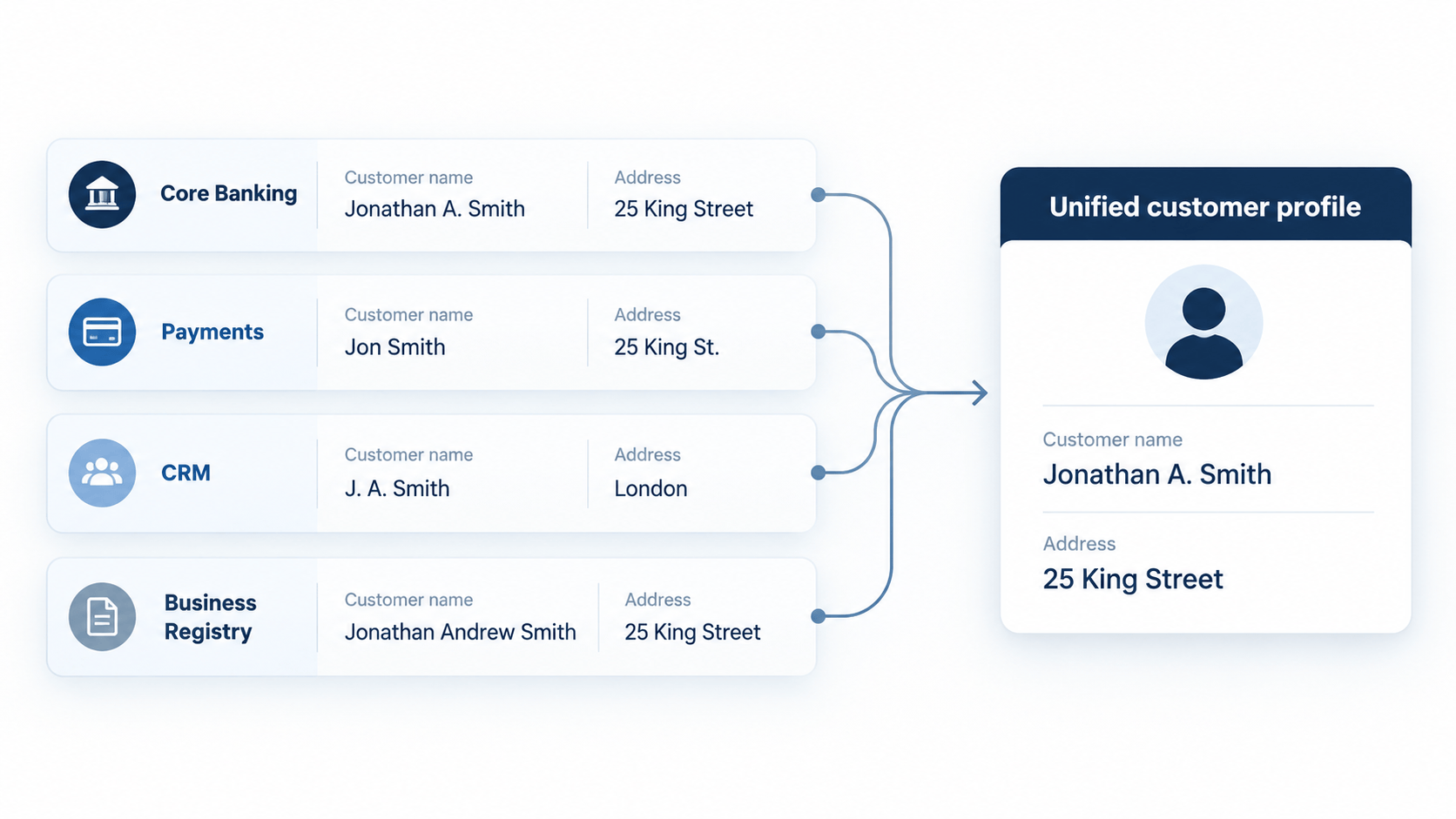
These records might represent the same person.
But they might not.
A reliable Entity Resolution process must use available attributes and contextual evidence to establish whether the records belong together.
Incorrectly merging customers creates risk. Failing to connect matching records can leave important relationships undiscovered.
Quantexa provides sophisticated Entity Resolution capabilities, but successful implementations still depend on well-designed data pipelines, appropriate configuration, high-quality source data, and careful validation.
Entity Resolution is not just a matching problem. It’s a data engineering and data quality problem at enterprise scale.
From Entity Resolution to Graph Analytics
Identifying a person or company across systems is only the beginning.
The next challenge is understanding how entities relate to one another.
This is where Quantexa Graph Generation and Network Analytics become important.
Connected data can reveal networks involving customers, businesses, beneficial owners, accounts, addresses, and transactions.
These relationships can support several critical banking use cases.
Anti-Money Laundering (AML): Identifying potentially suspicious relationships and transaction networks that require investigation.
Know Your Customer (KYC): Developing more complete customer profiles and understanding complex ownership structures.
Financial Crime Detection: Discovering relationships between entities that might otherwise appear unrelated.
Fraud Detection: Identifying potentially connected customers, accounts, organizations, or activities.
Customer Intelligence: Understanding customer relationships across products, accounts, and business entities.
The engineering challenge is to make these networks useful, accurate, and efficient to generate and explore.
A graph with millions of connections is not necessarily valuable. The value comes from identifying relevant relationships and presenting them in a way that supports better decisions.
The Real Challenge: Integrating Quantexa into Complex Banking Environments
Even a technically successful Quantexa implementation cannot deliver its full value in isolation.
Banks operate complex technology environments built over many years. Data may come from relational databases, legacy applications, enterprise integration services, cloud data platforms, and external providers.
Making everything work together requires expertise beyond any single platform.
SQL and Enterprise Data Integration
SQL remains fundamental to working with banking data.
Quantexa development projects often involve extracting, transforming, reconciling, and validating information originating from relational systems.
Data engineers need to understand source schemas, business rules, data quality issues, and how information changes across different systems.
Java and Backend Engineering
Java and backend development skills support the broader integration landscape surrounding Quantexa, including custom services, enterprise APIs, and connections with existing banking applications.
Angular and User-Facing Applications
Quantexa offers its own investigation and user interface capabilities.
However, some organizations also require custom portals, dashboards, workflows, or applications that consume Quantexa-generated intelligence.
This combination of Big Data, backend integration, and full-stack development is particularly useful in large banking environments where new analytical platforms must coexist with established enterprise systems.
Where Sotex Solutions Comes In
At Sotex Solutions, our engineers bring hands-on Quantexa development experience from engagements with banking clients, combined with strong backgrounds in enterprise software development and Big Data technologies.
Our team includes experienced full-stack and data engineers working with Quantexa, Apache Spark, Scala, SQL, Java, and Angular or React.
This combination enables us to contribute to Quantexa initiatives while understanding the wider software and data architecture in which those solutions operate.
Our technical capabilities are particularly relevant in the following areas:
Quantexa Development and Implementation Support
Contributing experienced developers to Quantexa implementation and enhancement projects, including work involving data pipelines, Entity Resolution, network analytics, and integration.
Apache Spark and Scala Engineering
Developing, maintaining, troubleshooting, and optimizing distributed processing workloads that support large-scale enterprise data processing.
Banking Data Integration
Working with complex relational databases, banking data structures, data transformations, and integration requirements across multiple systems.
Enterprise Application Development
Supporting the backend services, APIs, and user-facing applications that connect Quantexa with existing enterprise technology.
Extending Existing Engineering Teams
Providing experienced Quantexa developers who can collaborate with internal teams, consulting partners, and financial institutions on ongoing development initiatives.
Our advantage is not limited to familiarity with one platform.
It’s the combination of Quantexa expertise, Big Data engineering, and practical experience developing software for banking environments.
Looking for Experienced Quantexa Developers?
Whether you’re expanding an existing Quantexa implementation, developing data processing capabilities, or strengthening your banking technology team, Sotex Solutions can provide engineers with practical Quantexa experience and strong expertise in Apache Spark, Scala, SQL, Java, and enterprise software development.
Let’s discuss your Quantexa development and Big Data engineering needs.